My brother was so distracted by the woodwork when we arrived at the ryokan in Shirahama that he walked straight onto the tatami floor in his full-sized sneakers.
I watched the staff member’s eyes widen. She pivoted immediately into fast, polite Japanese, explaining that shoes never touch tatami. My brother smiled, amused by her energy but completely unaware of what she was saying. Mika translated quickly, and within seconds, the staff brought him slippers and showed him where to leave his shoes.
The moment passed, but I felt it lodge somewhere in my chest. That sharp awareness that I could make the same kind of mistake at any second.
Even after living here and marrying Mika, I still carry this. Later that evening, I stood in our room staring at the yukata (casual robe) hanging behind the door. I knew it was meant to be worn to dinner. I knew everyone else would be wearing one too. But I still felt oddly exposed, like I was about to walk into a formal dining room in pajamas. Was I tying it correctly? Would I look completely out of place?
I kept adjusting the tie. Mika was already dressed and waiting by the door.
We went down to dinner.
The meal began with a small glass of homemade umeshu (plum wine). Sweet, full, perfectly chilled. Just an appetizer, but it set a tone I wasn’t expecting. Everything slowed.
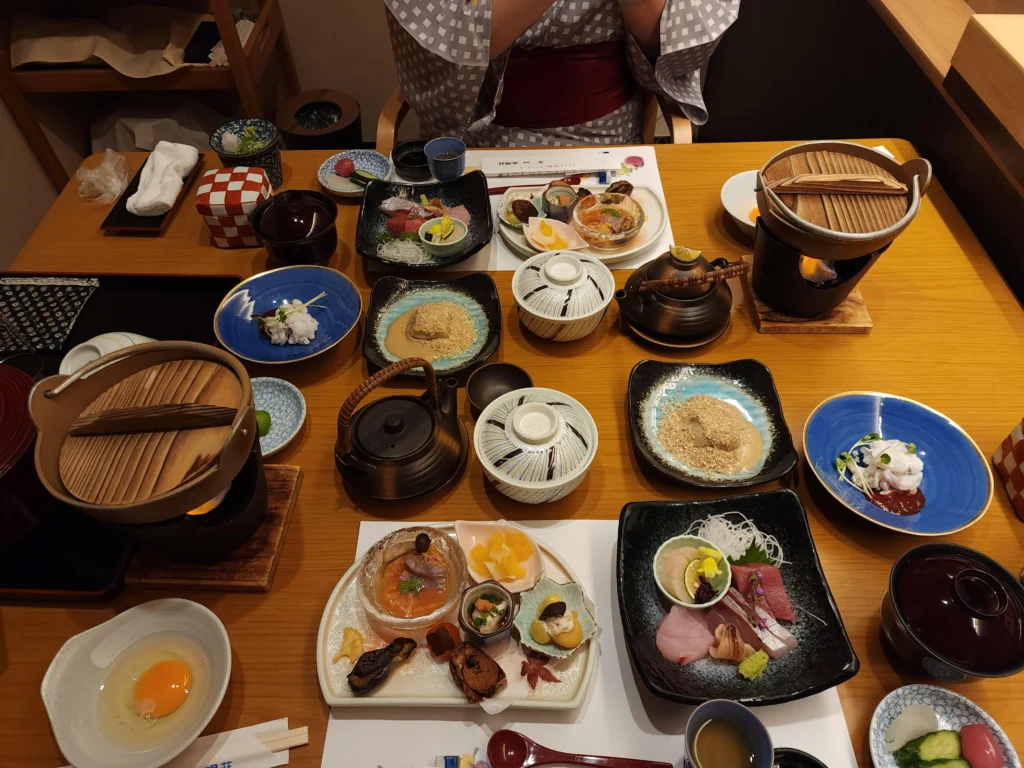
Then the kaiseki courses began. Since Shirahama is a fishing port, the sashimi was almost translucent, with a natural sweetness you only find when the ocean is a few hundred yards away. But it was the hot pot “nabe” course that shifted something for me.
The staff member brought out a small clay pot and set it on the table. She explained, in Japanese, what was inside: fresh local mushrooms, vegetables, and seafood from the morning catch. She described how they’d made the dashi, and the care in balancing the flavors. Then she lit the sterno flame underneath.
As the pot began to bubble, steam rising between us, I realized she wasn’t just serving food. She was sharing something she was proud of. There was no self-consciousness in her explanation. Just clarity and quiet confidence in the work.
I looked across the table at Mika. She was completely at ease, her posture soft in a way I rarely see when we’re traveling. She wasn’t performing relaxation. She was just… there. The hot spring baths earlier had already started the work. Now, watching her receive each course without second-guessing anything, I understood: the ryokan wasn’t asking me to get everything right. It was asking me to stop trying so hard.
When we returned to our room after dinner, the center table was gone. In its place, our futons had been laid out. Quilts smoothed, pillows positioned perfectly. The room had been entirely transformed while we were eating.
This is what omotenashi actually looks like. It’s not just attentive service. It’s the staff choreographing the entire experience around your comfort, anticipating transitions you didn’t even know were coming. They’d timed the turndown to our meal so we’d never have to wait, never have to see the in-between state of the room being rearranged.
The next morning, while we were at breakfast, they’d reverse it. Futons stored, table returned. I never saw them do the work. I only saw the result.
That invisible care is the heart of the ryokan. You’re not there to perform as the perfect guest. The staff is performing for you.
If you’re planning a ryokan stay and already feeling that familiar tightness in your chest, the worry that you’ll tie the yukata wrong, or use the wrong honorific, or somehow disrupt the quiet perfection of the place, I want you to notice that feeling.
Then I want you to remember that the ryokan is designed to dissolve it.
The yukata is there so you stop making decisions about what to wear. The set meal times are there so you stop planning. The room turndown happens while you’re gone so you never have to think about it. Every detail is arranged so you can let go.
Your nakai-san isn’t waiting for you to mess up. She’s watching for the moment you need something, often before you realize it yourself. When the staff explained that “nabe” course to me, she wasn’t testing my cultural literacy. She was inviting me into the care she’d already put into the meal.
The mistakes, my brother’s shoes, my yukata hesitation, didn’t matter. What mattered was whether I could stop performing long enough to receive what was being offered.
This week, look up a ryokan in Shirahama. As you scroll through the photos, pay attention to what you’re feeling. Are you wondering if you’ll be able to pick the right place, cataloging all the ways you might do it wrong? Or can you imagine yourself in one of those rooms, wearing that yukata, letting the schedule carry you?
That tension you’re feeling, the ryokan is built to dissolve it. But only if you let it.